Marxism and Form by Jameson Fredric;
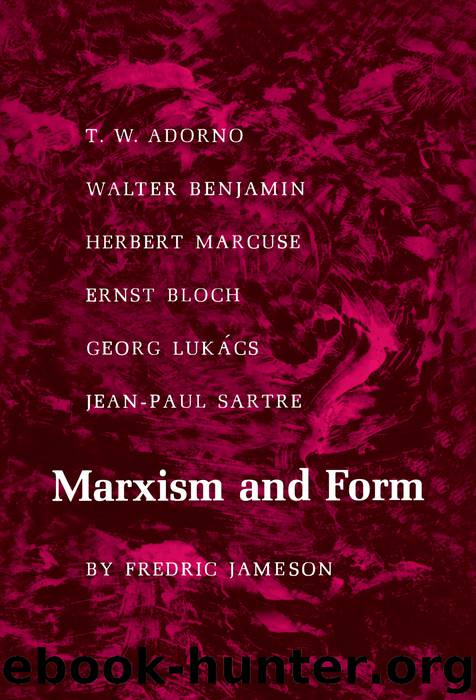
Author:Jameson, Fredric;
Language: eng
Format: epub
Publisher: Princeton University Press
Published: 2016-06-24T04:00:00+00:00
CHAPTER FIVE
TOWARDS DIALECTICAL CRITICISM
A PHENOMENOLOGICAL description of dialectical criticism? The contradiction is not so great as it might at first glance appear. The peculiar difficulty of dialectical writing lies indeed in its holistic, “totalizing” character: as though you could not say any one thing until you had first said everything; as though with each new idea you were bound to recapitulate the entire system. So it is that the attempt to do justice to the most random observation of Hegel ends up drawing the whole tangled, dripping mass of the Hegelian sequence of forms out into the light with it. So it is also that at some point or other books or essays on Marx dutifully end up as rehearsals of historical materialism as a whole. There is no content, for dialectical thought, but total content; and it is for this reason that phenomenology (like the other great contemporary philosophical systems not a discovery of new content, but an innovation in form) seems to have an answer to what would otherwise, for us, be an organizational dilemma. For phenomenology is precisely the attempt to tell not what a thought is, so much as what it feels like. It aims not at making statements about content (that being momentarily placed between parentheses), but at describing the mental operations which correspond to that content in all their temporal specificity. Its mode of proof, for the reader, consists not in logical argumentation, but rather in the shock, or the failure, of recognition.
In the preceding chapters we have given an account of contemporary work in the dialectic from a number of different points of view, the implication being that these “systems” or partial systems—Adorno on dialectical evolution in time; Benjamin, Marcuse, and Bloch on the essentially hermeneutic, or demystifying and at the same time restorative, nature of dialectical thinking; Lukács on the symptomatic relationship between the artistic construct and the underlying realities of social life itself; Sartre on the disguised and undisguisable nature of those realities as class antagonism—all ultimately complete each other, their apparent inconsistencies dissolved in some vaster dialectical synthesis. It is not the task of the present book to bring such a synthesis to ordered, philosophical, systematic exposition: yet, always provided we keep in mind the descriptive, phenomenological, deliberately subjective orientation of the following pages, there would seem to be room, alongside such local studies, for an evocation of dialectical literary criticism, and beyond it of dialectical thinking in general, as a form in time, as process, as a lived experience of a peculiar and determinate structure.
It is, of course, thought to the second power: an intensification of the normal thought processes such that a renewal of light washes over the object of their exasperation, as though in the midst of its immediate perplexities the mind had attempted, by willpower, by fiat, to lift itself mightily up by its own bootstraps. Faced with the operative procedures of the nonreflective thinking mind (whether grappling with philosophical or artistic, political or scientific problems
Download
This site does not store any files on its server. We only index and link to content provided by other sites. Please contact the content providers to delete copyright contents if any and email us, we'll remove relevant links or contents immediately.
4 3 2 1: A Novel by Paul Auster(12609)
The handmaid's tale by Margaret Atwood(7903)
Giovanni's Room by James Baldwin(7540)
Asking the Right Questions: A Guide to Critical Thinking by M. Neil Browne & Stuart M. Keeley(5892)
Big Magic: Creative Living Beyond Fear by Elizabeth Gilbert(5890)
Ego Is the Enemy by Ryan Holiday(5616)
The Body: A Guide for Occupants by Bill Bryson(5281)
On Writing A Memoir of the Craft by Stephen King(5054)
Ken Follett - World without end by Ken Follett(4861)
Adulting by Kelly Williams Brown(4683)
Bluets by Maggie Nelson(4682)
Eat That Frog! by Brian Tracy(4677)
Guilty Pleasures by Laurell K Hamilton(4565)
The Poetry of Pablo Neruda by Pablo Neruda(4233)
Alive: The Story of the Andes Survivors by Piers Paul Read(4143)
The Book of Joy by Dalai Lama(4119)
Fingerprints of the Gods by Graham Hancock(4116)
White Noise - A Novel by Don DeLillo(4091)
The Bookshop by Penelope Fitzgerald(3946)
